Showing posts with label VW. Show all posts
Showing posts with label VW. Show all posts
Frazer Nash cars business selling Porsche Sales, Service, and Parts... as odd as that is, is only a backdrop for a VW Type 2 pulling a Porsche 906... what a crazy world

Comments
0

Volkswagen NILS Single Seater EV launched in Frankfurt [video]
Volkswagen AG is presenting a car for the urban world of tomorrow at the Frankfurt International Motor Show (IAA): NILS. The single-seat electric vehicle reflects a new, fascinating form of minimalist mobility. The concept car - with its progressive aluminium space frame, wing doors and free-standing wheels - exhibits a high level of dynamic performance, yet travels with zero emissions and silently towards the future. The project is supported by the German Federal Ministry of Transport, Building and Urban Development.
Technically realistic and economically feasible. "NILS is a vehicle that anticipates the future. It looks as though someone has projected it back from the year 2030 to the world of today. This study melds sustainability, design and lifestyle in a new way. A high-tech vehicle from the Volkswagen company with an electric drive, but very realistically conceptualised," says Dr. Ulrich Hackenberg, member of the Board of Management and Head of Development for the Volkswagen Brand. Prof. Dr. Jürgen Leohold, Director of Volkswagen Group Research explains the project from the research perspective: "In the context of the growing influence of electric mobility, cutting edge vehicle concepts like these - which are based on intensive analyses of future and vehicle research and on strong networking ties to Marketing - will play an increasingly important role. That is because new, very target group specific requirements will be placed on cars with the advent of electric mobility.
These new vehicle concepts - together with the electrification of existing models - will help to advance electric mobility to a breakthrough." In this context, Dr. Ulrich Hackenberg explains further: "The goal of the NILS project is to work out a technically concrete and economically feasible vehicle concept for micro-mobility, which restructures individual transportation to make it more efficient and environmentally compatible based on electric drive technology." Prof. Dr. Jürgen Leohold adds: "Therefore, Group Research intensively analysed all facets of commuter transportation with the goal of making it sustainable for the future. The results of these analyses were made available to individual vehicle development departments. And so, all of the company's brands - from A for Audi to V for Volkswagen - are benefiting from the think tank of Group Research."
Networked know-how. Dr. Ulrich Hackenberg comments: "The close cooperation with Group Research has meant that we at Volkswagen are really able to put cutting-edge vehicle projects in motion. We benefit from the networked know-how of the company here. This also includes the Volkswagen Design Centre in Potsdam. There, under the leadership of Thomas Ingenlath, an entirely new interpretation of Volkswagen design was accomplished in NILS. Those viewing this concept car can look far into the future of our brand and of the automobile itself. NILS is anything but a dry-run exercise; it is very realistic. Despite its compact dimensions, the concept fulfils all safety requirements for contemporary vehicles, for example. Commuters would not only drive in an eco-friendly way, but would also be very safe in this car."
With a range of 65 kilometres, the 130 km/h NILS would certainly be the ideal vehicle for the majority of commuters in Germany. According to the German Federal Statistical Office, 73.9 per cent of all commuters residing between Berlin and Munich cover less than 25 kilometres on their way to work. So, NILS is designed to be a reflection of a new era.
NILS defines new segment
Electric traction changes mobility. Automobiles have always been mirrors of the times with their design styles and technological standards reflecting the status quo of a particular era. Consider Volkswagen: at the turn of the century, the age of downsizing gained momentum in the powertrain area. At the same time, a new quality of styling took hold, which today is still marked by maximum clarity and precision. Currently, we are experiencing yet another developmental thrust: the long-term breakthrough of electric traction. Many Group models in the higher vehicle classes are already available with hybrid drives, where the electric motor supports the conventional drive system. This emissions-reducing drive technology is now breaking into high-volume segments.
Golf with E-drive debuts in 2013. The first high-volume models with a pure electric drive will soon reach production readiness; the Golf, the best-selling car in the world, will debut with an electric drive (Blue-e-Motion) in 2013. In addition, electric traction will lead to entirely new concepts; they will result in vehicles that fulfil specific needs profiles more than ever. One of these needs profiles is that of commuters who commute to their jobs in their millions every day in the world's urban areas. For a long time now, public transportation has not always been the first choice of commuters for various reasons. In Germany, for example, about 60 per cent of all commuters travel by car according to the Federal Statistical Office; of these, over 90 per cent travel alone. Zero emissions vehicles like NILS will offer these frequent drivers a new eco-friendly mobility solution.
NILS leaves a small footprint in traffic
Narrower, lower, shorter, different. The concept is a very compact car that requires extremely little space in traffic. NILS is only 3.04 metres long, making it about 50 cm shorter than the new Volkswagen up! model. The width of the NILS, from wheel to wheel, is 1.39 metres; the body itself measures only 0.86 metres wide. The concept car is 1.2 metres tall. By means of comparison: a Porsche 911 is taller at 1.31 metres.
Design was created in Potsdam. More important than its dimensions is the layout of its body. NILS shares the same basic body layout as a Formula-1 race car: driver in the middle, engine in back, aluminium wheels outboard and free-standing. The 17-inch alloy wheels are equipped with 115/80 (front) and 125/80 (rear) tyres optimised for low rolling resistance. The clean, distinctive styling of the NILS car has its origins at the Volkswagen Design Centre in Potsdam. Designer Thomas Ingenlath, the centre's director, comments on the research vehicle: "NILS was designed to make a visual statement and transport a vision of the automotive future to the present. The car had to visually highlight the theme of sustainability, while showing a future-oriented look and simply being fun. I think that we have successfully integrated both of these aspects. Although our mission here was to come up with an entirely new body concept for the brand, NILS matches the Volkswagen design DNA 1:1." Consider the bumpers: it is no coincidence that they remind one of the bumpers on the new up! with their black borders around the impact surfaces. Thomas Ingenlath continues: "I am especially pleased that we managed to implement the concept of the 2 glass wing doors. This allowed us to create large transparent surfaces and simultaneously make entering and exiting the vehicle very comfortable, even in the most cramped of parking spaces."
NILS is tailored to commuting distances
65 km and 130 km/h. Although, or even because, NILS is so compact and lightweight (460 kg), it is a lot of fun to drive. It is an agile car with a top speed of 130 km/h, and it can accelerate to 100 km/h in less than 11 seconds. This is accomplished by an electric motor with a reasonably small 15 kW nominal power and short-term peak power of 25 kW. A lithium-ion battery supplies the electric motor with energy. The battery capacity (5.3 kWh) enables driving ranges of up to 65 km, depending on the style of driving. A battery of this size is relatively inexpensive, and its capacity is sufficient for this type of car. The research vehicle can be charged either via a conventional 230 Volt electrical outlet (maximum charging time 2 hours) or at an electric vehicle charging station. The plug port is located at the back underneath the rear lighting module.
Electric motor is a lightweight 19 kg. In setting up the electric drive system, engineers made use of the great wealth of experience Volkswagen has acquired in developing other concept cars such as the L1 and XL1 as well as future production vehicles like the Golf Blue-e-Motion or up! Blue-e-Motion. The centrepiece of the drive unit is the lightweight 19 kg electric motor together with its transmission and battery. Energy management is via a high-voltage pulse inverter, which - together with the 12 Volt DC/DC converter for the vehicle electrical system and the charger - forms an integral drive unit. It is the rear axle that is driven. All drive unit components are located compactly in an aluminium housing. The unit, including the drive shafts, is integrated at the rear of NILS.
Space for shopping. The motor, battery and all other components are so compact in their construction that there is still space for a small but practical bootspace above the drive unit. As on the Golf, for example, the bootlid is unlocked via the VW logo; in this case, the body-coloured area above the rear lighting module swings upwards. The space is laid out so that users can conveniently stow items from a classic shopping trip - a case of drinks and a bag, for example.
NILS is sporty and agile
Optimal weight distribution. With a vehicle like NILS, the customer target group would not only commute to work with zero emissions, but as described would also have a lot of fun doing it. That is because the lightweight NILS drives like a sports car with its pure mechanical steering and centrally positioned shell seat; from a standstill, the electric motor produces a maximum torque of 130 Nm, which is transferred to the rear axle via a one-speed transmission. For wheel control and suspension, there are double-wishbone suspensions front and rear; the ESP electronic stabilisation programme ensures that with all of its agile performance, NILS will still stay on course. The car's very good weight distribution between the front and rear axles contributes towards the ESP having to do as little as possible.
NILS brakes and accelerates automatically upon request
Innovative City Emergency Braking. Another important electronic assistant in NILS is City Emergency Braking. The continually active system uses a laser sensor (in the front VW logo) to detect the risk of an imminent collision, and at that moment it automatically brakes the car. Depending on the car's speed and the driving situation, City Emergency Braking can reduce the speed at impact and might even prevent an accident.
Automatic Distance Control. City Emergency Braking is a software extension of the automatic distance control system (ACC). Its full range of functionality is available in NILS. The ACC system also uses a laser sensor to measure the distance and relative speed to the vehicle ahead in traffic - parameters to which NILS automatically adjusts its speed. Beforehand, the driver preselects the desired following distance and vehicle speed, similar to a cruise control system. The automatic distance control system has intuitive controls with 3 new multifunction keys in the steering wheel. Two arrow keys are used to vary the vehicle speed (in open driving) and the distance to the vehicle in front. Another key between the 2 arrow keys is used to activate or deactivate the ACC system. The system itself can be used over the entire speed range of NILS; in addition, the system can even automatically brake the car to a stop, depending on the situation. Not only are the four disc brakes used to brake; electric traction by electric motor and battery regeneration can be used to brake as well, depending on the driving situation. Last but not least, Front Assist is integrated in the ACC system. This continually active system warns the driver of a potential collision; at speeds below 30 km/h, automatic braking can avoid a collision under some circumstances.
Digital instruments
TFT display as instrument cluster. The instrument cluster was tailored to the electric vehicle. The main feature here is a 7-inch TFT display. The vehicle's speed is shown digitally in the middle. Energy flow is visually represented by bar elements. Another graphic display offers information on the driving range.
Clever touchscreen. The second central instrument is a mobile multifunctional system like the one used in a similar form in the new up!: the Portable Infotainment Device (PID). It is snapped onto the A-pillar to the right of the instrument cluster. Via touchscreen, the driver controls functions related to "Navigation", "Radio", "Media", "Telephone", "Trip computer" and - to preconfigure the driving range - "Eco". At the start of the drive, the PID computes the expected driving range, then it not only displays the route on the map display, but also the radius and thereby the destinations that can be reached using the current battery charge.
Simple where it makes sense. To save on weight and costs, certain functional elements and controls are operated without electrical assistance. The side mirrors, for example, are adjusted manually, which is not really an inconvenience in an interior that is only 0.61 metre wide. There is no power assistance for steering either; however, this is no problem on a vehicle weighing less than 500 kg. Meanwhile, the heating and ventilation system has fully electronic control. The driver sets the temperature and blower setting via 2 controls in the form of electronic sliders; 2 additional sliders are used for the ventilation flap position (air flow direction) and seat heating. Located to the right of the steering column is the motor start-stop switch; this round, handy switch is also used to select the position of the single-speed transmission (D, N or R).
NILS relies on aluminium space frame body
Safe like a big car. The aluminium space frame body was designed to be a highly effective safety cell. The body-in-white - i.e. the basic structure without add-on parts or glass - is produced from extruded aluminium parts, cast aluminium and sheet aluminium. The roof frame, together with the wing door mounts, a sturdy roll bar behind the driver, the bootspace and the front bulkhead consist of high-strength sheet aluminium. Also extremely sturdy are the extruded aluminium parts; they are used in the area of the side sills, the transverse profiles and the crash-optimised longitudinal profiles (front and rear car sections). The housings for the drive unit and other elements consist of cast aluminium parts. All add-on body parts are made of plastic and aluminium. The front and rear side body parts are manufactured in aluminium. Parts made of high-strength plastic include the bumpers and the trim panels on the side sills.
Wing doors from 3 parts. The 2 wing doors are a work of art in their manufacture. Their frames consist of 3 main elements: an inner section, a crash reinforcement section and an exterior part. When they are closed, they offer optimal crash safety. The door windows are made of lightweight, scratch-resistant, layered polycarbonate. The front window is made of laminated safety glass.
See and be seen. Xenon and LED elements are used for the headlights, rear lights and indicators. In front, 2 bi-xenon modules handle the job of the dipped and main beam headlights. The indicator lights and daytime running lights are implemented as white and yellow LEDs. The daytime running lights are mounted on the front wheel trim panels, and these lights also serve as position lights for parking. In the acrylic glass of the rear lights - which are integrated in the rear section like small wings - the light generated by LEDs is routed via transparent semiconductors. Their electrical power consumption? Minimal. Which is just what you need with an electric vehicle.
Volkswagen Nils Concept Set to Debut at Frankfurt Motor Show

The tiny, single-seat Volkswagen Nils concept will make its public debut at the Frankfurt Motor Show later this month. It is supposed to offer sports car-like performance with zero emissions and silent propulsion.
Volkswagen says the Nils concept is designed just like a Formula 1 racer. Much like Audi’s Urban Concepts, the single seat is mounted in the center of the car, the engine resides just aft of the driver, and the 17-inch wheels — wrapped in low rolling resistance tires — are placed outboard of the body. Entrance into the cabin is provided by polycarbonate gullwing doors, one placed on each side of the car.The body has few sharp angles and two small rear fins to help with aerodynamics. Never mind the F1 inspiration: the look is more akin to a narrow egg placed on wheels.
The Nils is powered by a 15 kW electric motor – with a 25 kW over boost-like function – that draws juice from a 5.3-kWh lithium-ion battery. VW says that allows for a range of about 40 miles, and can be charged using a 230-volt outlet (the standard in Europe) in about two hours. According to Volkswagen, 73.9 percent of German commuters drive less than 15.5 miles on driving to work, making the Nils the right size and right range for urban commuters.
The Nils weighs only 1014 lbs, thanks to all-aluminum construction, and is expected to accelerate from 0-62 mph in under 11 seconds. The electric motor pushes out around 95 lb-ft of torque and sends powerto the rear wheels through a one-speed transmission.
To help quell nerves over the Nils’ diminutive size, the is equipped with a radar-based automatic braking system, a collision warning system, four disc brakes, and electronic stability control. The wing doors include a crash reinforcement section, and the aluminum space frame has been designed to act as a safety cell in the event of a collision.
The Volkswagen Nils concept will make its debut at the Frankfurt Motor Show next month.
Source: Volkswagen
VW to invest in renewable energy sources

Europe's biggest automaker, Volkswagen, plans to invest almost one billion euros ($A1.37 billion) in renewable energies over the coming years, a media report says.
VW will invest in an offshore wind park and is in talks with four companies with the goal of choosing a partner by the end of the year, the Financial Times Deutschland said, citing a source close to the matter.
The wind park is expected to have a generating capacity of 200 megawatts, about one fifth the capacity of an average Germany nuclear power plant, the report said, or about as much as 275,000 German households consume in a year.
Investing in wind, solar and hydroelectric electricity production will help VW meet CO2 emission limits that it has set for itself by around 2020, the newspaper said.
VW is of course also developing electric cars, along with all other major global auto manufacturers.
cool images from pour15minutesdamour.blogspot
1956 Heinkel Kabine,
advertising,
airplane,
art,
artist,
celebrity,
Kombi,
paintings,
pin up,
record player,
VW

I did not photo shop this, I think it's an original print

Wow, Kevin Bacon before stardom was a model for roller skates... who woulda guessed?

Huh, the famous car record player, but in a right hand drive car, first time I've seen that!

The Pan Am Strato Clipper


Not the Messerschmitt, it's the Heinkel Kabine


paintings by Samuel Michlap

all from the wide variety of intesting things found on http://pour15minutesdamour.blogspot.com/
VW to unveil Single-Seat Electric Car
Volkswagen is poised to unveil a single-seat, ultra-frugal, zero-emission electric car. The German carmaker also plans to offer a “full-service package” for customers of its electric cars by selling them power from renewable sources, Jürgen Leohold, head of research, told the Financial Times.
VW’s one-seat concept or experimental car will showcase the carmaker’s ambition to build vehicles that generate no carbon dioxide, even on a “well-to-wheel” calculation that takes into account the carbon dioxide generated by power plants.
“It’s a new kind of mobility – a new vehicle concept,” Mr Leohold said. “Also, it’s physics. If you limit a car to one person, you can make it smaller, less weight, you need less energy to transport the person, and then obviously … it can be better on CO2 and fuel efficiency”.
Mr Leohold said that the single-seater concept car, to be unveiled within weeks, was designed for limited purposes, such as commuting, and that most drivers would want a larger vehicle for longer trips.
He declined to reveal the car’s range, top speed or other details ahead of its unveiling.
VW’s research head said that the one-seater would be “even better” than the XL1 Super Efficient Vehicle, a diesel-electric plug-in hybrid capable of 313 miles per gallon which the company unveiled in January.
Mr Leohold said that the car’s CO2 count “depends on what kind of electricity you put in the battery”, but if powered from renewable sources it would be “zero”.
Single-passenger vehicles are a rarity in the car industry apart from niche products such as the Segway scooter – which is prohibited from roads in many countries – or the ill-fated Sinclair C5, a British-designed electric tricycle launched in 1985 that flopped because of safety and other concerns.
Familienfest 17 at Deerpark Winery and Car Museum


Jim Beam's publicity stunt of selling whisky in bottles that look like cars and other things was brilliant. People who aren't bottle collectors still buy the ones that pertain to their hobby, they are that well made


Porsche in 1977 used this VW van as a rolling machine and parts shop

photo from Road and Track, taken by Joe Rusz
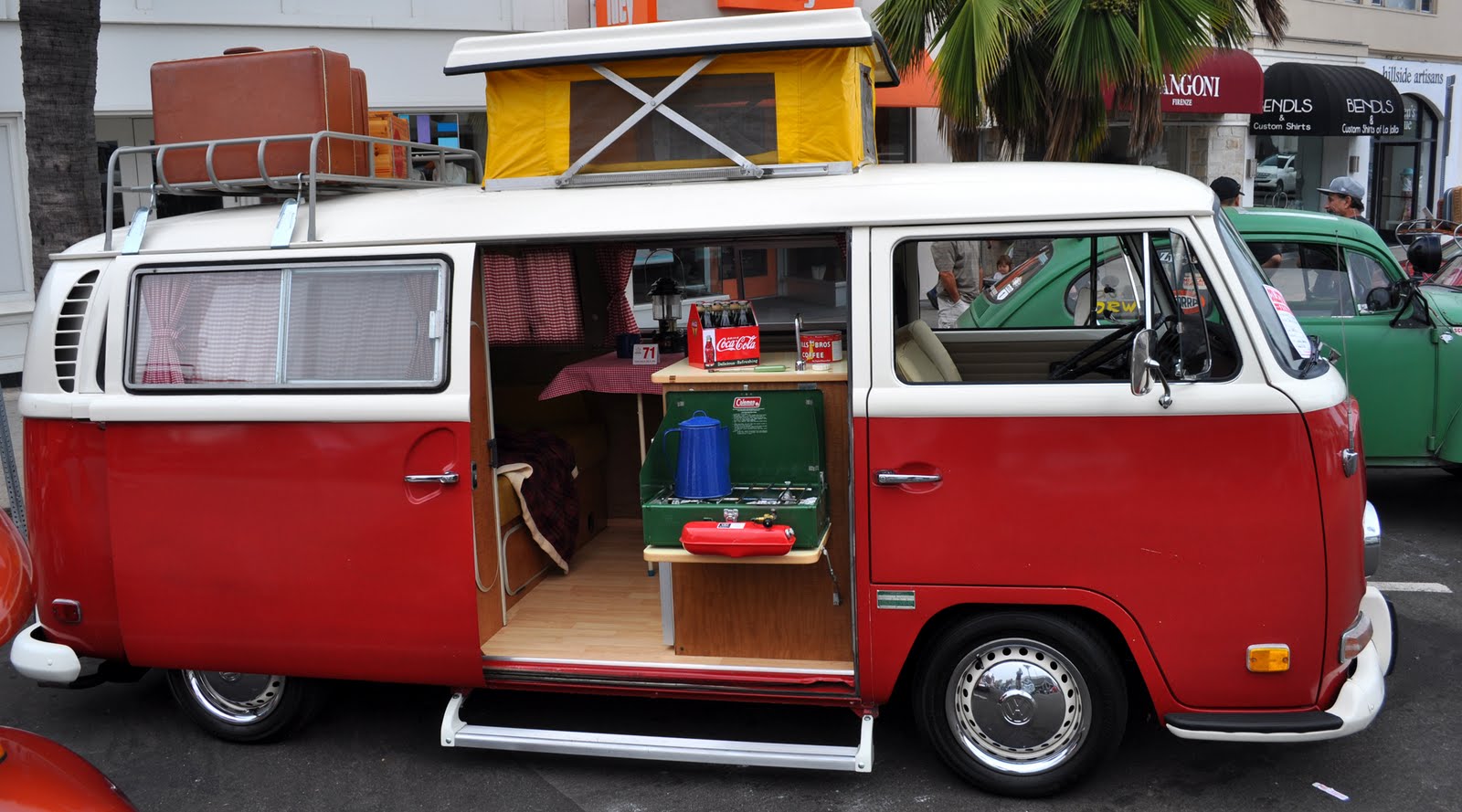
The "All VW car show" in LaJolla today... about time LaJolla was the site of a car show!


this is the worst condition I've seen an Allstate one wheel trailer in, but it sure looks right at home behind the rusty bug




Cool method of hanging the license plate

Harlequin Edition, yeah, who knew?


great helmet


Having a book made of your restoration, that is cool!


this ashtray reminds me of the funny labels, the "Das Schmokegedunka " etc pidgen German http://justacarguy.blogspot.com/2011/05/humor-found-in-volkswagens-pidgin.html


this is funny... quite the sales pitch.


thanks to the organizer, Howard Singer, for kick starting car shows in LaJolla, and to P.A. for spreading the word and letting people know it was happening
Subscribe to:
Posts (Atom)


