Buy a Lancia Stratos. It had a 2.4 liter V6 Ferrari engine. Bertone coachbuilt the bodies.
It won the World Rally Championship 3 times.
They only made 500 for public sale
The Lancia 037 won the World Rally Championship, beating the Audi Quattro, and was the last 2 wheel drive to win the championship
The Lancia Fima 8.32 had the Ferrari V8 from the Ferrari Mondail and 308 . It was a 3.0 liter though, and he body was by PininFarina
Or if someone should stumble over a lost ASA 1000 Gt. Not going to happen, they were very very rare and were only built from 1963 to 1966. They cost 40% more than the nearest competitive car, the Alfa Giulia Sprint
Showing posts with label Lancia. Show all posts
Showing posts with label Lancia. Show all posts

Lancia Stratos HF
 The Lancia Stratos HF, widely and more simply known as Lancia Stratos, is a car made by Italian car manufacturer Lancia. The HF stands for High Fidelity. It was a very successful rally car, winning the World Rally Championship in 1974, 1975, and 1976. A Bertone designed concept car called the Lancia Stratos Zero was shown to the public in 1970, but shares little but the name and mid-engined layout with the Stratos HF version. Lancia presented the Bertone designed Lancia Stratos HF prototype at the 1971 Turin Motor Show, a year after the announcement of the Stratos Zero concept car. The prototype Stratos HF (Chassis 1240) was fluorescent red in colour and featured a distinctive crescent-shaped-wrap-around windshield providing maximum forward visibility with almost no rear visibility. The prototype had three different engines in its early development life: the Lancia Fulvia engine, the Lancia Beta engine and finally for the 1971 public announcement, the mid-mounted Dino Ferrari V6 producing 192 hp (143 kW). The Stratos was a very successful rally car during the 1970s and early 1980s. It started a new era in rallying as it was the first car designed from scratch for this kind of competition. The three leading men behind the entire rallying project were Lancia team manager Cesare Fiorio, British racer/engineer Mike Parkes and factory rally driver Sandro Munari. Lancia did extensive testing with the Stratos and raced the car in several racing events where Group 5 prototypes were allowed during the 1972 and 1973 seasons. Production of the 500 cars required for homologation in Group 4 commenced in 1973 and the Stratos was homologated for the 1974 World Rally Championship. The Ferrari Dino V6 engine was phased out in 1974, but 500 engines among the last built were delivered to Lancia. Production ended in 1975 when it was thought that only 492 were made. Manufacturer of the car was by Bertone in Turin, with final assembly by Lancia at the Chivasso plant. Powered by the Dino 2.4 L V6 engine that was also fitted to the rallying versions, but in a lower state of tune, it resulted in a power output of 190 bhp (142 kW; 193 PS), giving the road car a 0-60 mph time of just under five seconds, and a top speed of 144 mph (232 km/h). The car was sold as the Lancia Stratos Stradale.
Lancia Stratos(kit car) / TOP GEAR in HQ
 For racing, the engine was tuned up to 280 hp (209 kW) and even to 560 hp (418 kW) with a single KKK turbocharger. However, turbocharged versions were only allowed to compete in Group 5 and were never as reliable as their naturally aspirated counterparts. The car won the 1974, 1975 and 1976 championship titles in the hands of Sandro Munari and Björn Waldegård, and might have gone on to win more had not internal politics within the Fiat group placed rallying responsibility on the Fiat 131 Abarths. As well as victories on the 1975, 1976 and 1977 Monte Carlo Rally, all courtesy of Munari, the Stratos won the event with the private Chardonnet Team as late as 1979. Without support from Fiat, and despite new regulations that restricted engine power, the car would remain a serious competitor and proved able to beat works cars in several occasions when entered by an experienced private team with a talented driver. The final chapter of the Stratos' racing career at international level took place as late as 1981, at the Tour de Corse Automobile, another World Rally Championship event, with a victory by longtime Stratos privateer Bernard Darniche. When the Fiat group favored the Fiat 131 for rallying Lancia also built two Group 5 turbocharged 'silhouette' Stratos for closed-track endurance racing. These cars failed against the Porsche 935s on closed tracks but proved successful in hybrid events. While they failed in the Tour de France Automobile, one of these cars won the 1976 Giro d'Italia Automobilistico, an Italian counterpart of the Tour de France Automobile. Unfortunately one of the cars was destroyed in Zeltweg, when it caught fire due to overheating problems. The last surviving car would win the Giro d'Italia event again before it was shipped to Japan to compete in the Fuji Speedway based Formula Silhouette series, which was never raced. The car would then be sold and reside in the Matsuda Collection before then being sold to the renowned collector of Stratos', Christian Hrabalek, a car designer and the founder of Fenomenon Ltd, who has the largest Lancia Stratos Collection in the world, 11 unique Lancia Stratos cars, including the fluorescent red 1971 factory prototype and the 1977 Safari Rally car. His interest in the car led to the development of the Fenomenon Stratos in 2005. Another unique Group 5 car is the Lancia Stratos HF of Austrian Rallycross driver Andy Bentza. The car was first driven by his Memphis team mate Franz Wurz, father of Formula One pilot Alexander Wurz. In 1976 Wurz claimed the first ever European Rallycross title recognised by the FIA with the car, by then still equipped with a 2.4 litre engine. For the ERC series of 1977 Wurz was entrusted with two experimental crankshafts by Mike Parkes, to bring the engine capacity up to just under 3000 cc. For 1978 Bentza took the Stratos over from Wurz, sold his own 2.4 litre Stratos to compatriot Reneé Vontsina, and won the GT Division title of the ERC. The one and only 3.0 litre Stratos was raced by Bentza till the mid 1980s, is nowadays still his property and ready to race. However, one of the two experimental crankshafts received from the Lancia factory was destroyed during a Rallycross event in the early 1980s.
 The Lancia Stratos 0 (or Zero) pre-empted the Lancia Stratos HF prototype by 12 months and was first shown to the public at the Turin Motor Show in 1970. The futuristic bodywork was designed by Marcello Gandini, head designer at Bertone, and featured a 1.6 L Lancia Fulvia V4 engine. The body was wedge-shaped, finished in distinctive orange and was and unusually short (3.58 m (141 in)) and wide and only 84 cm (33 in) tall, and shared little with the production version. The Zero appeared in Michael Jackson's 1988 film, Moonwalker as well as in his music video for Smooth Criminal. In 1978, Bertone created and designed a concept car based on the Stratos called the Sibilo, although it was never intended for production.At the Geneva Auto Show of 2005, a British design firm known as Fenomenon debuted a retromodern concept version of the Stratos, designed by Christian Hrabalec and following its exhibition at the Frankfurt show, developed by Prodrive. The concept was based around a mid-mounted 419 bhp (312 kW; 425 PS) V8. It turned out that this company had the rights to the Stratos name. Following the stalled Fenomenon project, one interested backer was convinced to fund a one-off model. Commissioned by Michael Stoschek (a keen rally driver and chairman of Brose Group) and his son, Maximilian. Announced in 2010, the new Stratos based on the overall design and concept of the original seventies Stratos and was designed by Pininfarina. The car made use of a Ferrari F430 Scuderia as a donor car, using the chassis (shortened by 200 mm (7.9 in)) and much of the mechanical elements including the 4.3L V8 engine. It was reported that if sufficient interest was shown it would result in a small production run.
Lancia Delta
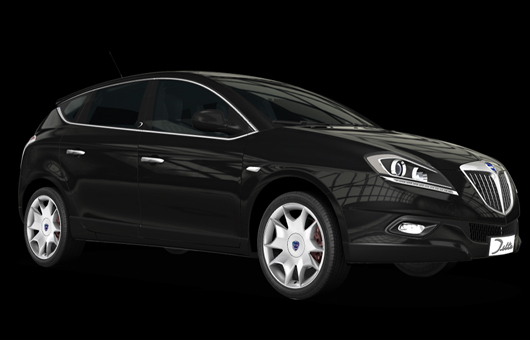 The Lancia Delta is a small family car produced by Italian automaker Lancia with the first generation being produced between 1979 and 1994, the second generation running from 1993 until 1999, and the third generation Delta entering production in 2008. It was first shown in Frankfurt Motor Show in 1979. The Delta is best known for its World Rally Championship career in the late 1980s and early 1990s, when it dominated rallying. Lancia offered road-going versions of these competition cars — the Lancia Delta HF4WD and Integrale. The first Delta was a five-door hatchback designed by Giorgetto Giugiaro and released in 1979. For a period of time, it was also sold in Sweden by Saab Automobile, badged as the Saab 600. For a few years after its launch, the Delta was one of the most contemporarily styled cars of its class in Europe and was voted 1980 European Car of the Year. The Delta range was first introduced to the United Kingdom in 1980 and remained virtually unchanged until 1986, when small changes were made to the cars' body shape, the engines updated and the four-wheel drive model introduced.
Car test LANCIA DELTA
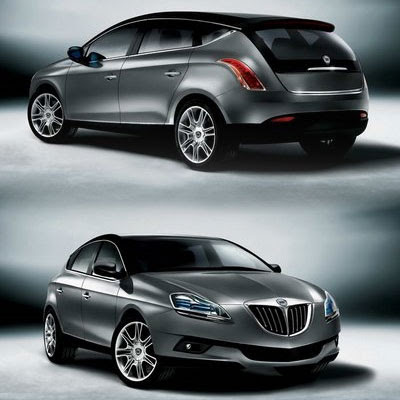 The successor to the original Delta, the 'Nuova Delta', was introduced in 1993 based on the Fiat Tipo platform. The Nuova Delta was targeted at customers more interested in comfort and convenience than overall performance and power. The Nuova Delta was offered with engine versions up to 193 PS (142 kW; 190 hp), but without four-wheel drive. Until 1995 only five-door hatchback body styles was offered, when the three-door was introduced under the name HPE. In 1996 two 1.8-litre engines were introduced (one with variable valve timing) and the naturally-aspirated 2.0 was discontinued. The Delta was dropped from Lancia's lineup in 1999. The Dedra did get a replacement, the Lybra, which was not offered with a hatchback body style. In September 2006 Lancia officially announced the revival of the Delta name, with new cars to be built on the Fiat C platform, as reported in CAR Magazine. The world première of the new HPE concept was held at the 63rd Venice International Film Festival. The new Lancia Delta was unveiled at the 2008 Geneva motor show. The Lancia brand was reintroduced to Scandinavian, Russian and Turkish markets in 2007. Commercial ambitions for the car appear more cautious than for earlier Deltas: British press reports nevertheless highlight plans for the new Delta to spearhead a return by Lancia to the UK market during 2009, in part to celebrate Lancia's centenary. Delta as well as being an historical name from Lancia’s past is also being interpreted this time around by Lancia as a mathematical symbol that stands for change, difference and evolution. Designed by the Lancia Style Centre, this car is aimed at the luxury end of the small family car segment. The Delta is 4.52 metres (178.0 in) long, 1.797 metres (70.7 in) wide and 1.499 metres (59.0 in) high, and has a wheelbase of 2.7 metres (106.3 in), 10 centimetres (3.9 in) more than the Fiat Bravo.
 The new Delta offers a number of options and equipment including a Bose Hi-Fi radio incorporating a CD player and MP3 file reader with steering-wheel mounted controls, the Blue&Me system developed with Microsoft, and brand new satellite navigation system developed with Magneti Marelli. Further technical equipment included to effect the ride and handling will include an advanced ESC (Electronic Stability Control) system and SDC suspension (with electronic damping control, also by Magneti Marelli). The new Delta also has a driving assistant that gives more safety, an electric eye monitors the road and gives feedback to steering wheel to suggest corrections to the driver. The car is available also with semi-automatic parking assistant. For 2011 the Delta got some changes like new Chrysler derived 'family' grille, trim level changes and 105 PS (77 kW; 104 hp) 1.6 Multijet diesel engine for lower consumption and CO2 figures. The new version of Delta will be presented in Geneva Motor Show 2011.[Engines available at launch were 120 PS (88 kW) and 150 PS (110 kW) 1.4 litre Turbojet petrol engines and 1.6 litre 120 PS (88 kW) MultiJet diesel, 2.0 Multijet with 165 PS (121 kW) and 1.9 Twinturbo Multijet with 190 PS (140 kW). A new petrol unit was launched later: 1.8 Di Turbojet with 200 PS (147 kW).
Lancia Stratos HF
 The Lancia Stratos HF, widely and more simply known as Lancia Stratos, is a car made by Italian car manufacturer Lancia. The HF stands for High Fidelity. It was a very successful rally car, winning the World Rally Championship in 1974, 1975, and 1976.The Stratos was a very successful rally car during the 1970s and early 1980s. It started a new era in rallying as it was the first car designed from scratch for this kind of competition. The three leading men behind the entire rallying project were Lancia team manager Cesare Fiorio, British racer/engineer Mike Parkes and factory rally driver Sandro Munari. The bodywork was designed by Marcello Gandini, head designer at Bertone, and the technical layout was loosely based on a (Lancia Fulvia V4 powered) concept car called Stratos Zero which had been first shown at the Turin Motor Show in 1970. The body was wedge-shaped, and unusually short and wide, providing maximum traction. In 1971 Lancia presented the Lancia Stratos HF prototype at the Turin Motor Show. The prototype (Chassis 1240) was fluorescent red in colour and featured a distinctive crescent-shaped-wrap-around windshield providing maximum forward visibility with almost no rear visibility. The prototype had three different engines in its early development life: the Lancia Fulvia engine, the Lancia Beta engine and finally the mid-mounted Dino Ferrari V6. Lancia did extensive testing with the Stratos and raced the car in several racing events where Group 5 prototypes were allowed during the 1972 and 1973 seasons. Production of the 500 cars required for homologation in Group 4 commenced in 1973 and the Stratos was homologated for the 1974 World Rally Championship. The Ferrari Dino V6 engine was phased out in 1974, but 500 engines among the last built were delivered to Lancia. Production ended in 1975 when it was thought that only 492 were made. Manufacturer of the car was by Bertone in Turin, with final assembly by Lancia at the Chivasso plant. Powered by the Dino 2.4 L V6 engine that was also fitted to the rallying versions, but in a lower state of tune, it resulted in a power output of 190 bhp (142 kW; 193 PS), giving the road car a 0-60 time of just under five seconds, and a top speed of 144 mph (233 km/h). The car was sold as the Lancia Stratos Stradale.
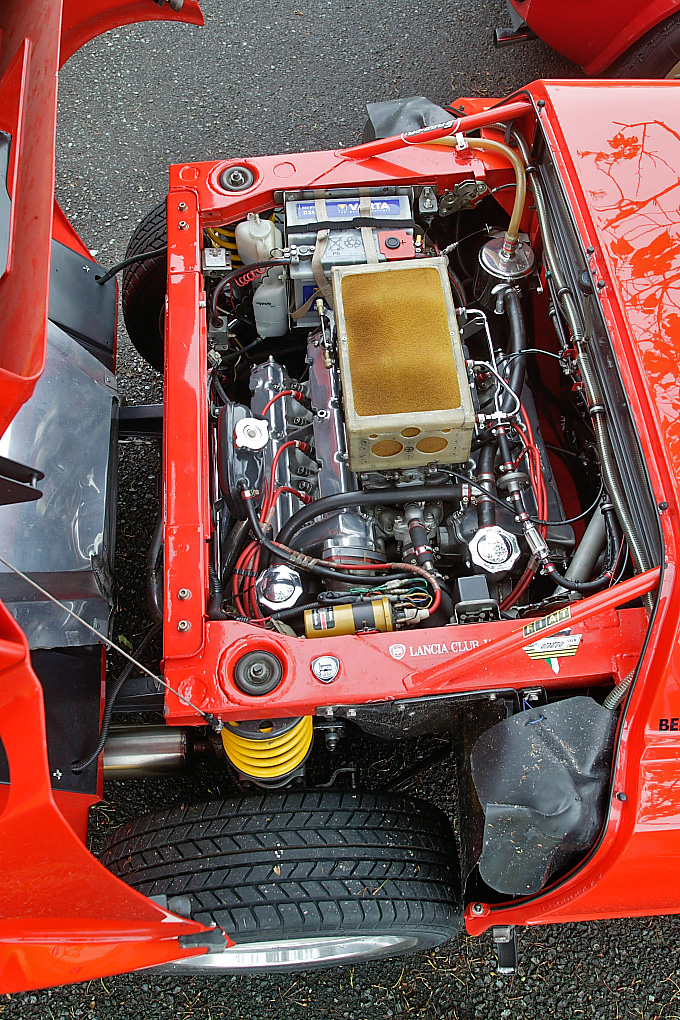 For racing, the engine was tuned up to 280 hp (209 kW) and even to 560 hp (418 kW) with a single KKK turbocharger. However, turbocharged versions were only allowed to compete in Group 5 and were never as reliable as their naturally aspirated counterparts. The car won the 1974, 1975 and 1976 championship titles in the hands of Sandro Munari and Björn Waldegård, and might have gone on to win more had not internal politics within the Fiat group placed rallying responsibility on the Fiat 131 Abarths. As well as victories on the 1975, 1976 and 1977 Monte Carlo Rally, all courtesy of Munari, the Stratos won the event with the private Chardonnet Team as late as 1979. Without support from Fiat, and despite new regulations that restricted engine power, the car would remain a serious competitor and proved able to beat works cars in several occasions when entered by an experienced private team with a talented driver. The final chapter of the Stratos' racing career at international level took place as late as 1981, at the Tour de Corse Automobile, another World Rally Championship event, with a victory by longtime Stratos privateer Bernard Darniche. When the Fiat group favored the Fiat 131 for rallying Lancia also built two Group 5 turbocharged 'silhouette' Stratos for closed-track endurance racing. These cars failed against the Porsche 935s on closed tracks but proved successful in hybrid events. While they failed in the Tour de France Automobile, one of these cars won the 1976 Giro d'Italia Automobilistico, an Italian counterpart of the Tour de France Automobile. Unfortunately one of the cars was destroyed in Zeltweg, when it caught fire due to overheating problems. The last surviving car would win the Giro d'Italia event again before it was shipped to Japan to compete in the Fuji Speedway based Formula Silhouette series, which was never raced. The car would then be sold and reside in the Matsuda Collection before then being sold to the renowned collector of Stratos', Christian Hrabalek, a car designer and the founder of Fenomenon Ltd, who has the largest Lancia Stratos Collection in the world, 11 unique Lancia Stratos cars, including the fluorescent red 1971 factory prototype and the 1977 Safari Rally car. His interest in the car led to the development of the Fenomenon Stratos in 2005.Another unique Group 5 car is the Lancia Stratos HF of Austrian Rallycross driver Andy Bentza. The car was first driven by his Memphis team mate Franz Wurz, father of Formula One pilot Alexander Wurz. In 1976 Wurz claimed the first ever European Rallycross title recognised by the FIA with the car, by then still equipped with a 2.4 litre engine. For the ERC series of 1977 Wurz was entrusted with two experimental crankshafts by Mike Parkes, to bring the engine capacity up to just under 3000 cc. For 1978 Bentza took the Stratos over from Wurz, sold his own 2.4 litre Stratos to compatriot Reneé Vontsina, and won the GT Division title of the ERC. The one and only 3.0 litre Stratos was raced by Bentza till the mid 1980s, is nowadays still his property and ready to race. However, one of the two experimental crankshafts received from the Lancia factory was destroyed during a Rallycross event in the early 1980s.
 In 1978, Bertone created and designed a concept car based on the Stratos called the Sibilo, although it was never intended for production.At the Geneva Auto Show of 2005, a British design firm known as Fenomenon debuted a retromodern concept version of the Stratos, designed by Christian Hrabalec and following its exhibition at the Frankfurt show, developed by Prodrive. The concept was based around a mid-mounted 419bhp V8. It turned out that this company had the rights to the Stratos name.Following the stalled Fernomenon project, one interested backer was convinced to fund a one-off model. Commissioned by Michael Stoschek (a keen rally driver and chairman of Brose Group) and his son, Maximilian. Announced in 2010, the new Stratos based on the overall design and concept of the original seventies Stratos and was designed by Pininfarina. The car made use of a Ferrari F430 Scuderia as a donor car, making use of the chassis (shortened by 200mm) and much of the mechanical elements including the 4.3L V8 engine. It was reported that if sufficient interest was shown it would result in a small production run. The car appeared in Michael Jackson's 1988 film, Moonwalker as well as in his music video for Smooth Criminal. In the anime Ex-Driver the main character Lisa Sakakino drives a Stratos. In the manga and anime series Ghost in the Shell, Batou drives a Stratos. Wheeljack, a character in the Transformers franchise, transforms into a Stratos sporting Alitalia racing livery.
Novo Lancia Stratos
 O novo Lancia Stratos foi desenvolvido em parceria com Pininfarina. E utiliza o motor do Ferrari F430 Scuderia que tem 540 cavalos de potência.
Ele pesa 1247 quilos e faz de 0 aos 100km/h em apenas 3,3 segundos e chegar a velocidade máxima de 274 km/h. O modelo foi todo desenvolvido em fibra de carbono.


Subscribe to:
Posts (Atom)


