A Hyundai apresentou fotos do novo i30 2012 que será apresentado oficialmente no Salão de Frankfurt.


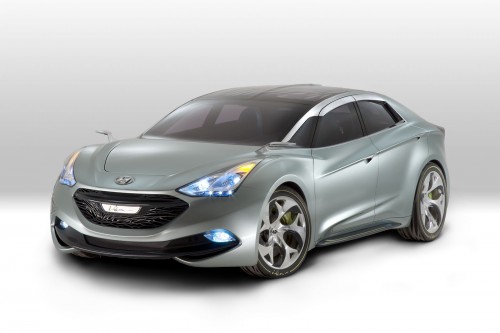 Exotic Hyundai i40 With Beautiful Lighting
 Elegant Hyundai i40 From Back
 Red Newest Hyundai i40
 Hyundai i40 Interior
 Hyundai i40 With The Top Speed
 Hyundai i40 Sedan Hatchback
 Awesome Hyundai i40 In White
 Exotic Hyundai Verna With Silver Color
 Hyundai Verna Luxury Interior
 Hyundai Verna Beautiful Lighting
 Hyundai Verna Steering Wheels
 Luxury Hyundai Verna
 Hyundai Verna Transform With High Technology
 Glossy Blue Hyundai Verna
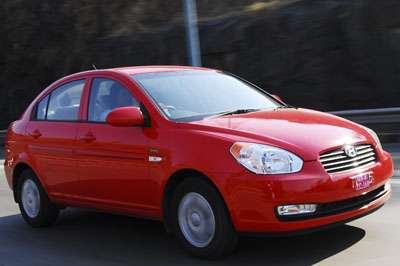 Red Hyundai Verna On The Road
 Hyundai Verna Show Up
 The Hyundai Elantra in South Korea, is a compact car from Hyundai of South Korea launched in October 1990 for the 1991 model year, and now in its fifth generation. The Elantra was formerly marketed as the Lantra in Australia and some European markets. In Australia, this was due to the similarly named Mitsubishi Magna Elante model. This gave rise to disagreement from other motor manufacturers, and the name was standardized as "Elantra" worldwide in 2001 (with the exception being Korea and Malaysia still selling under the name "Avante"). Launched in 1990 , the Elantra (codename J1) received a mid-term facelift in 1993. The Elantra was powered by a Mitsubishi-designed 1.6 L (1596 cc) straight-4 This DOHC 16-valve 1.6 L unit produced 113 hp (84 kW) at 6000 rpm and could push the Elantra to 60 mph (97 km/h) in 9.5 seconds. The quarter-mile (0.4 km) run took 17.1 seconds and produced 80 mph (129 km/h). Top speed was 116 mph (187 km/h). The Elantra got 22 mpg[clarification needed](10.7 L/100 km) in the city cycle. Starting in 1993 there was also a Mitsubishi-designed 1.8 L (1836 cc) straight-4 engine available the 1.8L unit that produced 124 hp (99 kW) at 6000 rpm. Launched in 1995, the second generation (codename J2) was offered as a sedan and station wagon. It was sold in the Korean market as the Avante in sedan form and Avante Touring in station wagon bodystyle. Between 1996 and 1998, the Elantra was marketed as the Bimantara Nenggala (1.8 litre petrol) in Indonesia. (The Cakra (1.5 litre petrol) was based on the Accent (X3).)
 An all-new model (codename XD) was launched in 2000. The wagon was dropped in favor of a five-door hatchback. Starting in 2001, all American models came with standard front and front side airbags, air conditioning, power locks, power windows and power steering. This simplified dealer inventories and repairs and also sought to improve Hyundai's image of 'value' cars. In 2003, the Elantra received a facelift for all models (codename XD2). The facelift gave the Elantra new headlights and taillights, a new grille, new front and rear bumpers, a refreshed hood and trunk, and a refreshed dashboard. A redesigned Elantra sedan (designated HD) debuted at the 2006 New York Auto Show for model year 2007. In North America, the Elantra also offers the most interior room in its class, leading the United States Environmental Protection Agency (EPA) to classify it as a mid-size car. Beijing Hyundai launched a redesigned Elantra called the "Hyundai Elantra Yue Dong" for the Chinese market with an updated exterior. The engine lineup includes 1.6- Gamma and 2.0-liter Beta II gasoline inline-four engines, and a 1.6-liter turbodiesel inline-four. Only the 2.0-liter engine is offered in North America. All engines feature improved fuel economy over previous versions. A five-speed manual transmission is standard and a four-speed automatic is optional. Hyundai began producing the Avante "LPI Hybrid" and it was launched in the South Korean domestic market in July 2009. The Avante LPI (Liquefied Petroleum Injected) is the world's first hybrid electric vehicle to be powered by an internal combustion engine built to run on liquefied petroleum gas (LPG) as a fuel. The Hyundai Avante LPI is a mild hybrid and the first hybrid to adopt advanced lithium polymer (Li–Poly) batteries.
 Hyundai offers a Hyundai i30 wagon in the US and Canada marketed as the "Elantra Touring". Elsewhere, the same vehicle is marketed as the Hyundai i30cw.The fifth generation Avante, codenamed "MD", debuted at the 2010 Busan International Motor Show in April 2010. It features a 1.6L gasoline direct-injection engine, producing 103 kW (138 hp) and 167 Nm (123 lb-ft) torque, mated to a new 6-speed automatic or a 6-speed manual transmission. The design continues Hyundai's "fluidic sculpture" styling theme first seen in the 2011 Sonata. The new model went on sale in August 2010 in South Korea, and is expected to begin selling between end of 2010 and early 2011 as a 2011 model. The US version of the fifth generation Elantra debuted at 2010 Los Angeles Auto Show. It is powered by a new 1.8L Nu engine producing 148 hp (145 hp-PZEV) and 131 lb-ft (130 lb-ft-PZEV). EPA estimates for the new Elantra are 29 mpg-US (8.1 L/100 km; 35 mpg-imp) in the city and 40 mpg-US (5.9 L/100 km; 48 mpg-imp) on the highway. The fuel economy was increased with a low coefficient of drag, just 0.28. The Elantra will be available in two trim levels-GLS and Limited. Some of the premium features will be heated front and rear seats, proximity key entry with electronic push button start with immobilizer, navigation with touch screen. Mitsubishi Motors of Australia complained that Elantra was too close to its Elante trim level (last used on the 1991 Magna), and Lotus (as well as Kia) in the UK and Europe suggested it was too close to its Elan name, and its Kia counterpart. By 2001, both the Elan and the Elante had ceased production but the Avante's renaming remained necessary as Audi owned the Avant name in Europe.
 The Hyundai Veloster is a compact sport coupe set to begin sales in the Summer of 2011. It was released on January 10, 2011, at the Detroit auto show, and will fill the void left when Hyundai discontinued the Tiburon after the 2008 model year. Hyundai states the production model is to receive a direct-injected 1.6 liter 138 hp (103 kW), 123 lb·ft (167 N·m) (@ 4,850 rpm) torque, 4-cylinder engine. A 6-speed manual gearbox is standard while a 6-speed dual-clutch transmission (DCT) with paddle shifters is also available as an option. The DCT transmission is developed by Hyundai and is the first dual-clutch transmission from the company. The Veloster will achieve an estimated 40 mpg-US (5.9 L/100 km; 48 mpg-imp) fuel economy, but does not yet have an official EPA rating. A turbocharged version will be available later on. The car includes 17 inch wheels and 4-wheel disc brakes as standard features. A turbocharged 1.6 Gamma GDI was introduced in the 2011 Seoul Motor Show. It generates 208 hp at 6,000 rpm with 195 ft-lbs of torque from 1,600-5,000 rpm. This engine will be available in 2012.
 The car is different from many competitors as it has one door on the driver side and two on the passenger side in U.S.-bound models. European models will have four regular doors. The Veloster will also use Hyundai's new BlueLink system, which is similar to OnStar used in GM vehicles, providing customers with automatic crash notification, vehicle diagnostics, etc. Pricing is expected to start around US$17,000. While the car was being showcased at the Detroit auto show, it had already been tested and reviewed by "wheels", a car magazine based from UAE. The Hyundai Veloster concept, a 1+2 three-door, glass-roofed hatchback concept car, was unveiled by Hyundai at the 2007 Seoul Motor Show. It is the third in a series of cars styled by the company at its Namyang Design Center in Hwaseong, Korea. Its name is a combination of the words "velocity" and "roadster". The platform is based on the same front wheel drive ones in Hyundai Accent and Hyundai Elantra. The car concept was unveiled in 2007 Seoul Motor Show with the final production version released on January 10 at the Detroit Auto Show.
 Under the hood is an all-new small (for North-America) 1.6-liter direct injected gasoline engine called "Gamma". It produces an estimated peak output of 138 hp (103 kW) at 6,300 rpm and maximum torque of 123 lb-ft (167 Nm) at 4,850 rpm. It also features Dual Continuously Variable Valve Timing (D-CVVT), an electronic throttle control, a roller timing chain, variable induction and innovative anti-friction coatings such as CrN Physical Vapor Deposition (PVD) coating and Diamond Like Carbon (DLC) coating. Pretty high-tech, but it doesn't stop there. The Gamma can be mated either to a 6-speed manual or a 6-speed dual-clutch automatic transmission. Dual-clutch transmissions keep most of the fuel-economy benefits of manuals, but with the convenience of automatics. Pretty much a win-win. "This powertrain also has an Active Eco mode which modifies engine and transmission control for improved fuel economy that translates into more than a seven percent improvement in real-world fuel economy." The Hyundai Veloster weights 2,584 pounds, more than 400 pounds lighter than the Scion tC. I would really have liked to see a stop-start anti-idling system to improve city MPG, but that doesn't seem to be in the cards for now.
 The Hyundai Sonata is a mid-size car manufactured and marketed globally by Hyundai Motor Company. From the sixth generation onwards, it is known as the i45 in the Australian and New Zealand markets. The first Sonata was only for the Korean domestic market. The vehicle was unveiled in South Korea in November 1985. Engine choices include 1.8L or 2.0L I4 (The latter also finding its way into the 1987 and later Stellar, and in MPI form the 1986 Hyundai Grandeur.) The body was based on the Hyundai Stellar. The Y2 Sonata was part of Hyundai's expansion in North America after the success of the Excel. It was introduced in South Korea on June 1, 1988. It was then introduced in Canada in September 1987 as a 1988 model, and in 1988, as a 1989 model in the United States. The exterior was designed by Giorgetto Giugiaro of ItalDesign. The vehicle received a mid-term facelift in 1991. It replaced the Stellar as Hyundai's large family car. Sonatas were built in Ulsan, Korea, and in Bromont, Quebec. The Sonata was designed by Hyundai and featured Mitsubishi's engineering, including the platform from Galant Σ and its 2.4 L 110 hp (82 kW) Sirius I4 engine as used in American-market models. A 3.0 L V6 based on the Mitsubishi 6G72 arrived in 1990. The U.S. model received the 2.0 L engine for the 1992, replacing the original 2.4 L engine.
 The Y3 Sonata debuted in 1994, as a 1995 model. The base engine in most markets was a 2.0 L 77 kW (105 PS; 103 hp) Sirius I4, but there was a 3.0 L, 107 kW (145 PS; 143 hp) Mitsubishi V6 option in some markets. This generation continued after the demise of the Bromont, Quebec plant in September 1993. After that, all Sonatas would be built in Korea, until the opening of the Beijing Hyundai plant in December 2002. The 1994 model of the Sonata was the first to be sold in the UK without having to be privately imported. It was available as an 4 door saloon only, with a v6 engine and also had as standard: ABS, air conditioning, an alarm, alloy wheels, body coloured bumpers, CD Multichanger, climate control, cruise control, driver's airbag, electric driver's seat, electric mirrors, electric sunroof, folding rear seats, front electric windows, front fog lights, a full size spare wheel, heated mirrors, isofix child seat anchor points, leather seat trim, lumbar support, PAS, passenger's airbag, rear electric windows, remote locking, Sat Nav, side airbags, and traction control. There was also an additional CDX model with a 2.0lt engine, which has most of the standard model's features, minus the CD Multichanger, climate control, cruise control, Sat Nav, traction control. A facelift for the Sonata (Y3 facelift) in 1996 saw modifications to the front and rear. The four-cylinder engine was also increased to 92 kW (125 PS; 123 hp) for that year as well. A new model arrived in 1998, launching the (EF) series. Engines were 2.0L 136 hp, 2.4 L 138 hp (103 kW) Hyundai Sirius and a 2.5 L 170 hp (127 kW) Hyundai Delta V6. A special 10-year warranty was available. Known serious problems include a failure of input and output speed sensors on automatic transmission models equipped with the V6. The Kia Optima (called the Magentis outside of the United States) was based on the same automobile platform of this generation of Sonata and shared the same doors and some other panels. This Sonata also shared a platform with the first-generation Hyundai Santa Fe, a compact crossover SUV.

 The NF Sonata was launched in August 2004 in Korea, based on a new platform created from the project NF. The company's first all-aluminum I4 engine, dubbed Theta, debuted in the new Sonata. Engine choices at launch were a 2.4L I4 rated 164 bhp (122 kW) at 5800 rpm and a 3.3L V6 rated 237 bhp (177 kW) V6. The diesel version was used as a taxicab in Singapore. Diesel versions are available in Europe and New Zealand. The U.S. May 2005 launch of the new Sonata coincided with the production commencement at the company's first U.S. assembly plant, in Montgomery, Alabama. Classified by the U.S. Environmental Protection Agency as a large car, the fourth generation was 2 in (50.8 mm) longer and taller and 1 in (25.4 mm) wider than the previous generation. Standard features in U.S. models included anti-lock braking system/electronic stability control/traction control system as well as six airbags (driver/front passenger front and side, and side curtain). The redesigned vehicle was unveiled at the 2008 Chicago Auto Show as a 2009 model year vehicle. The production version was sold as the Hyundai Sonata Transform in Korea, and the model debuted elsewhere as an 'early' 2009 model. The styling was done primarily at HATCI (Hyundai-Kia America Technical Center, Inc) in Superior Township, Michigan. The redesign features revised engines, front fascia and chrome 3 bar grill, taillights (turn signals became red), jewel-projector headlights, new 10-spoke wheel cover designs for the Limited models (as opposed to sharing the 5-spoke design from the SE model),and an extensively revised IP (Instrument Panel). Hyundai adopted "slush molding,” a production technique that enables a much higher grade of texturing and shaping of the IP surface. The YF models were originally developed in 2005, with a development cost of ₩450 billion (US$ 372 million*). Sales of the vehicle in South Korea began on 2 September 2009, before the production vehicle's South Korean launch. In South Korea, The 6th Sonata delivers its 2-liter Theta II MPi gasoline engine (Max output 165 PS (121 kW; 163 hp), Max torque of 20.2㎏·m). Its fuel economy is more than 11% improved. For the US market, Hyundai uses their new direct injection 2.4 liter four cylinder engine. With direct injection technology this new engine will improve gas mileage over previous models and produces 201 PS (148 kW; 198 hp) at 6300 rpm and 25.5 kg·m (250 N·m; 184 lb·ft) at 4250 rpm. It is part of the Theta II engine lineup. Furthermore, all engines are offered with a new six-speed automatic transmission. The 6th Sonata is built on hot-stamped ultra high-strength steel.The 2011 Hyundai Sonata Hybrid sales began near the end of February 2011. The Sonata Hybrid drivetrain combines a 2.4-liter engine with six-speed automatic transmission, and a 30kW electric motor and lightweight lithium polymer batteries to produce a full gasoline-electric hybrid with 37 miles per US gallon (6.4 L/100 km; 44 mpg-imp) in the city and 39 miles per US gallon (6.0 L/100 km; 47 mpg-imp) on the highway. This powertrain will be share by the 2011 Kia Optima Hybrid.
 The Hyundai Tucson or Hyundai JM (Joyful Mover) in Japan, is a compact crossover SUV built and marketed by the Hyundai Motor Corporation. In Hyundai's lineup, the Tucson fits below the Santa Fe and Veracruz. The vehicles are named after the city of Tucson, Arizona. The first generation Tucson launched in 2004. It shares its Elantra-based platform with the redesigned 2005 Kia Sportage. The Tucson is in the same class as the Toyota RAV4, Honda CR-V and Ford Escape. In the United States, the Tucson is offered in base GLS, mid-line SE, and top-tier Limited (formerly LX) trim levels for 2007 models. Earlier 2005 and 2006 models were offered as GL/GLS/Limited. Standard equipment includes air conditioning, cruise control, six airbags, electronic stability control, a CD player, alloy wheels, remote keyless entry, and premium cloth seats. The SE adds to the roster with contrasting gray body cladding, a different alloy design, an AM/FM/Cassette/CD as well as fog lights and a front windshield wiper de-icing grid. The Limited adds leather seating surfaces, a 6-disc in dash CD changer, body-colored cladding, automatic climate control, and heated seats. The SE and Limited are only available with the 2.7-litre V6. The GLS comes only with the 2.0-litre four cylinder. The Tucson offers modest cargo space but its easy-to-fold seats can expand this volume. Even the front passenger seat folds flat for extra-long cargo.
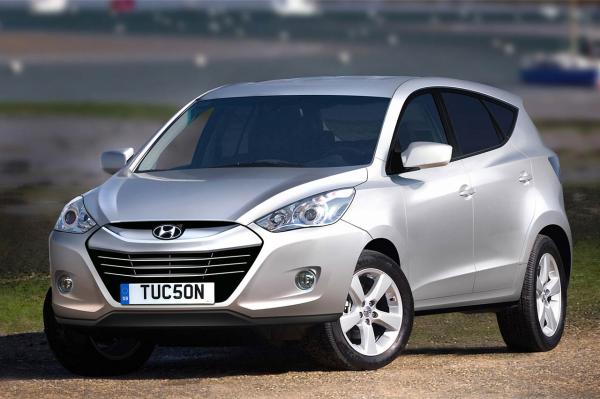 There are dual-stage frontal impact airbags, torso side-impact airbags built into the front seats, and curtain airbags for side-impact protection for front and rear passengers.Changes for 2006 were minimal. The LX became the Limited and got color-coded cladding, automatic climate control, and a high-performance sound system . The GLS retained the gray cladding but 'HYUNDAI' is no longer branded into the cladding on the front doors. The GLS also got improved cloth seats with the option of a heating element. Both GLS and Limited got redesigned alloy wheels. The base GL remains unchanged.Changes for 2007 were also minimal. The GL and GLS trims were renamed to GLS and SE, respectively, to match the standard for all new Hyundai vehicles.2009 Tucsons see minor restyling and trim changes. Tucson Fuel Cell Electric Vehicle (FCEV) is a test vehicle for Hyundai's 2nd generation hydrogen fuel cell. The vehicle includes a 80 kW electric motor by Enova Systems of Torrance, California, UTC Fuel Cells by South Windsor, Connecticut, 152V battery co-developed by Hyundai Motor Co. and LG Chem in Seoul, Korea, 152 litres (33 imp gal; 40 US gal) hydrogen storage tanks developed by Dynetek Industries Ltd. of Calgary, Alberta, Canada. The vehicle has range of 300 kilometres (186.4 mi) and top speed of 150 km/h (93 mph). The vehicle was unveiled in 2005 Los Angeles Auto Show. Tucson FCEV completed a 4,300-mile (6,900 km) journey as part of the Hydrogen Road Tour 2008. It is an Italian version of Tucson 2.0 capable of using both petrol and LPG fuels. The Tucson received accolades from Canadian Car of the Year Best New Crossover award for 2005. Hyundai Tucson named as one of the most reliable vehicles from 2009 Consumer Reports reliability survey.

 In Europe, Hyundai ix35 (also called 'Hyundai Tucson ix') replaced Hyundai Tucson name. The ix35 was unveiled in 2009 Frankfurt Motor Show. The power output, fuel-efficiency, comfort and safety features have been all upgraded. Known by the project name LM, it took 36 months and 280 billion won (approx. US$225 million) to develop. Saeki Yoshikazu, Toyota engineer, who is a chief engineer of Toyota RAV4 said, "I test drove Tucson ix. Even I think Tucson ix is a very good vehicle. It is a very stylish, too."[The ix35's styling was reported to be based on Hyundai ix-onic concept. The ix35 was penned by former BMW designer Thomas Buerkle at Hyundai's Russelsheim design studio in Germany and continues the company's stlyling language, marketed as "fluidic sculpture". The compact sports utility vehicle has sweeping coupe-like lines, a premium vehicle feel and comes with features unavailable on its predecessor.Tucson/ix35 is equipped with one of three engines: an all-new 2-litre diesel R engine or one of two Theta-II gasoline engine variants (2.0L or 2.4L). The automatic transmission is Hyundai’s all-new six-speed design. The diesel engine, available outside of North America, meets the Euro-5 emissions standards and achieves 15.4 kilometers per liter fuel economy with maximum power output of 184 horsepower. The 2.0L gasoline engine has a fuel economy of 11.7 kilometers per liter with 166 horsepower. In South Korea, the diesel engine is offered in both front-wheel-drive and all-wheel drive configurations, while the 2.0L gasoline engine is available only in front-wheel-drive. The North American versions are powered by either the 2.0L or a 2.4-liter four-cylinder gasoline engine producing 176 horsepower mated to the six-speed automatic transmission. The 2.4L engine makes almost the same power as the previous generation V6 engine while managing 20% better fuel economy than the previous generation four-cylinder.The second-generation Hyundai Tucson earned 'Top Safety Pick' award from Insurance Institute for Highway Safety (IIHS) in the US.


